The sovereignty of God is the primary message of the Old Testament. As Psalm 139 explains, "The Lord sits enthroned in the heavens, his kingdom rules over all." The prophets speak of God over all nations, pronouncing his words not only to Israel, but also to each nation: "He shall judge between nations, and shall decide disputes for many peoples." (Isaiah 2:4) God is not just the God of Israel, but the God and creator of the whole world and all peoples. As John Piper says, "When we say God is sovereign, we mean he is powerful and authoritative to the extent of being able to override all other powers and authorities. That’s my effort at a definition." (What is the Sovereignty of God?)
The sovereignty of God is absorbed into another proclamation in the New Testament. Jesus's primary message is "The time is fulfilled, and the kingdom of God is at hand. Repent and believe in the gospel." (Mark 1:15) Let me untangle this a little. First, the kingdom of God is not a place or a time. It is God's ruling, his action, his influence in all of the heavens and the earth. The message of God's rule so present in the Old Testament is now being announced as the good news in the New Testament with the emphasis that the kingdom is "at hand." Jesus is proclaiming the good news that the kingdom is now accessible in ways it has never been accessible before. Roughly speaking, the sovereignty of God is the kingdom of God.
Now let's explore what that means. It is well-known that the kingdom of God is "already, but not yet." God's kingdom has never not existed. He has always had power and authority over all he has made. Jesus was not announcing the kingdom coming from non-existence with his presence.The kingdom is now accessible through Jesus in ways that it was not accessible before. This is how the kingdom is "already." God's sovereignty is also "already" as seen in the Old Testament.
But we also know that the kingdom of God is "not yet." God rules over all, but his kingdom is not fully manifested in this present age. We anticipate God's rule and influence to be much greater. We anticipate that it will be absolute in the sense that we will not be able to hide from it or avoid it any longer. I believe this is also the current status of God's sovereignty. God is able to override all other powers and authorities. God has won the war over all powers and authorities. But God's sovereignty is not complete in this age because there are other rulers and authorities that interfere with God and his kingdom. So we are taught to pray, "Thy kingdom come, Thy will be done on earth as it is in heaven." We pray this because God's kingdom has not fully come and his will is not fully done on earth as it is in heaven.
But even more exciting, we can understand much about God's sovereignty by studying and pondering Jesus's teaching on the kingdom in the parables. God's influence in the kingdom and his rule as our Lord cannot be separated. So, it would generally follow that God's sovereignty is like a treasure in a field and a pearl of great value. But his rule is also like a sower throwing seed on different kinds of soil or a man who has an enemy plant weeds in his field. (Matthew 13) Like the kingdom of God, the sovereignty of God is not in any trouble in this present age. It is always at hand and never at a loss even though there are other rulers and powers set against it, doing what God does not want them to do.
I believe that Jesus's teaching on the kingdom of God stretches over all the great themes of the Bible and the deepest concerns of humankind. Not only does the kingdom of God draw in the sovereignty of God, it also draws in justice, grace, and the church. Each of these we see as "already, but not yet." They are fully present in the will and work of God, but thwarted by God's permission according to his good and loving judgment. We see perfect justice in Jesus and in the kingdom of God. We see complete grace as well. We also experience some of the called-out saints of the church. When some people talk about justice, they are really looking to the kingdom of God. The same with grace and the church. So the parables of the kingdom of God have much to teach us in all these areas.
Jesus teaching on the kingdom of God also shows us how the aspirations of humankind can fall short of what God is doing now. The "already, not yet" aspect of each of these important areas teach us that God wants to be with us more than over us. God wants to be our friend more than to be fair. God wants us to grow in grace more than get his grace. God wants our life to be church more than for church to be our life. All of these are evident in the present reality of the kingdom of God and are expressed in these different areas as well. It is not surprising that the Master teacher would know this and give us what we need to navigate these ideas with grace and truth.

My scribbled ideas I kept on scraps of paper, now online.
About Me

- Matt Filer
- I long to see Christ formed in me and in those around me. Spiritual formation is my passion. My training was under Dallas Willard at the Renovare Spiritual Formation Institute. One of my regular prayers is this: "This day be within and without me, lowly and meek, yet all powerful. Be in the heart of each to whom I speak, and in the mouth of each who speaks unto me."
Showing posts with label church. Show all posts
Showing posts with label church. Show all posts
Wednesday, April 15, 2020

Monday, June 27, 2016
Two Kinds of Slavery
All who are led by the Spirit of God are sons of God. For you did not receive the spirit of slavery to fall back again into fear, but you have received the the Spirit of adoption as sons, by whom we cry, "Abba! Father!" The Spirit himself bears witness with our spirit that we are children of God, and if children, then heirs - heirs of God and fellow heirs with Christ, provided we suffer with him in order that we may also be glorified in him. (Romans 7:14-17, ESV)Two Spirits
"The Spirit himself bears witness with our spirit." Here is one of the clearest pictures of the "still, small voice" Elijah and many other friends of God have detected. Through the agency of our own spirit, God speaks. He speaks to us through us. In this passage, Paul identifies the Spirit of adoption as the one who speaks through our own spirit of our dear place in God's hands and heart.
In contrast there is another spirit at work. Another voice has spoken to us through our self-absorbed flesh, the systems that support this pride all around in the world, and the being that pushes and orchestrates it all - Satan. The voice is the voice of slavery that pulls each person toward fear. Many live is fear due to the slavery they sense. The spirit of slavery may very well be the Devil himself and his work, which Jesus came to destroy. He came to destroy the bondage to sin and the spirit that accompanies it.
Bondage to sin is accomplished by being "weakened by the flesh." Our determination to live life without God and by the power of our natural abilities makes us unable to live a life pleasing to God or even ourselves. We fail miserably. We suffer deeply, knowing we cannot manage our lives, but we blame God for making a life unmanageable. We find some comfort in building up our pride through various deeds and distractions. We also find God's presence in his words, his works, and his ways only fills us with fear leading to loathing or indifference. Such is the way of the flesh. It brings a spirit of slavery that leads to a hateful fear of God or an indifference to God.

The Spirit bears witness to this life within us through the cry of "Father" that breaks out from our hearts for God. The Spirit uses our spirit as the voice for this cry. Another witness to our adoption is that we suffer with Christ. We suffer in the presence of sin instead of seeking it out. We seek God out instead of just suffering his presence. The thoughts and feelings associated with this love for God as Father and with the suffering of sin against him is the testimony of the Spirit through our spirits pointing to the new life in us.
Knock It Down or Cover It Up
There are two primary forms of religion that operate under the spirit of slavery. Both lead to self-righteousness. One form manages sin by speaking against it and feeling bad about it. The other manages sin by trying to cover it up with certain good deeds or rituals. Sin does not die in either religion, but ends up leading people away from Christ and his gospel and leading to further disappointment and corruption.

In both of these types of religion, sin is managed instead of destroyed. The efforts to knock sin down or cover it up must be maintained. When the will of the person or group is weakened and slackened, the sin resurfaces. Religion then becomes the managment of such sin and the ways to maintain control. This is not the teaching of Jesus nor the way of the Spirit.
Sin can only be destroyed through forgiveness. Forgiveness is only received through the peace of a re-established relationship. Forgiveness found through peace with God demonstrated and established through Christ at the cross makes such a relationship possible. Both God's complete love for sinners and God's absolute rejection of sin are evidenced through Jesus' work on the cross. We are forgiven, kept alive by his love, and scrubbed clean by his anger at evil. Forgiveness is accomplished for the purpose of relationship. Without the relationship, forgiveness has no meaning.
Sin management methods are ways of seeking forgiveness without relationship. It seeks to make God happy without actually seeking him out. It seeks to be right with God without actually being right with God. Sin cannot be condemned or covered away, though. God must take it from us manually, from our hands into his, for destruction. Christ came to take our sin from our very own hands and breath his Spirit into our very own breaths. Sin will only die in this "face to face" encounter with God in Christ. There is nothing automatic about it. Whether fast or slow, such freedom must come directly to a person through an encounter with God.
Forgiveness Is Freedom
Forgivenss is certainly mentioned, but not really enacted or trusted. People hear about forgiveness, but are not brought into relationship. Instead they are excused from sin and brought to work for the all-to-human endeavors of managing sin and its consequences. In their lives they are taught how they can keep their sin at bay without letting it destroying them. Sins are defined by rules instead of relationships, by what hurts the organization instead what hurts the soul, and by what can be seen and controlled instead of what happens in the hidden parts of one's life. The best they can offer are methods for coping.
In some cases, forgiveness that leads to freedom is called heresy. We must feel bad about sin. We must try to cover it up. Statements that oppose these "golden rules" are treated with great suspicion, fear, and anger. The managers of sin management set up their organizations to avoid or even condemn such freedom. We find such places to be filled with rules and rituals concerning church and its leaders with very little about the kingdom of God. The church receives all the attention and and concern and work and it is assumed the kingdom of God will take care of itself.
It turns out that sin does need our attention. It needs our attention to continue. Sin dies without adequate attention. With Jesus, seeking the kingdom of God was the focus of his attention and the church and its leaders would "take care of themselves." A good relationship with God is what matters to Jesus, and sin (both individual and corporate) will take care of itself. The fear of sin and the extensive structures erected to manage it inside and outside of our lives come from slavery to sin - an existence apart from the influence and action of God in human life. The solution lies in the personal reconnection of the human life to God in his words, his works, and his ways in the form of being received as a child and student. God as "Father."
The Keys to Freedom
Abandoning church does not answer these problems. Even "starting over" involves some level of rehabilitation from the ideas of sin managment that dominates the modern church setting. No matter how big or small, in homes, churches, or coffee houses, young or old, the prevalence of sin management makes its presence felt. Fierce individualism has never been the path forward for followers of Jesus who works to build his church.
It turns out that sin does need our attention. It needs our attention to continue to exist. Sin dies without adequate attention. So in every age, people have needed to come face to face with God, to turn their attention to him. From the beginning of time, that is what God has sought and developed. Through various mediators and helps, he has sought once again to walk with each person the cool of the day as he did in the Garden long ago. He still works in this way through his church, even if some have forgotten about this invitation. The best reminders are those who will once again walk with God, allowing his presence to teach and keep them, to burn and heal them, to gather and unite them. We give the cold shoulder to sin and our attention to God.

Being physical beings, we need places and times and groups to find such meetings with God. We do not merely approach him abstractly. Churches provide such a meeting ground. They are not the only place or time or group where people can find God, but they do supply his address for those who would seek him. The church is faithful enough to provide those who want to find Christ with encouragement and help and a place to serve. The church is broken enough to provide those who do not want to find Christ with discouragemnt and disappoinment and a place to complain about.
Wednesday, June 5, 2013
The Naked Guest
"Two men went up to the temple to pray: one a Pharisee, the other a tax collector." (Luke 18:10)
The house of God is open.
The meal is spread out.
The conversation is slow.
The table is low.
When I enter this house
I never hear,
"What are you doing here?"
They call my name,
but will I answer?
Do I know it?
The greatest weapon of pride
that keeps me from tabling
with the Lord
are the words,
"I just don't have time for that."
The doorway to the house
is the cross.
To enter, in confession,
all clothes are stripped,
all possessions dropped.
Naked I come,
but I arrive at the table
dressed in glory.
At any other home,
where people gather alone,
this naked visitor,
this empty traveler
is unwelcome and unexpected.
At the house of God,
though he worries about his welcome,
he is seen a long way off.
And though his brother will not welcome him,
he is clothed and celebrated.
His brother receives warm welcomes everywhere
and he thinks he deserves them.
But this naked guest
is only welcomed by God
and his company.
The naked guest finds his home
in a church that is
a place of worship and
a house of prayer.
Here is a doorway to fellowship with God.
His brother will find his home
in a church that is
a human gathering,
a place of religion.
Here is a warm welcome for all pride and false confidence.
Without confession, I will not be recognized by God.
He knows my true self, my right name.
Do I know? Will I answer?
Jesus says "I never knew you" to this pretend self.
Jesus says "Come to me" to a contrite heart, a broken spirit.
As a naked guest, let me come
and cling to the cross!
Pretend selves die
and false confidence falters
and all is left behind
for a chair
at the table of the Trinity.
 |
| htrccsherman.org |
The meal is spread out.
The conversation is slow.
The table is low.
When I enter this house
I never hear,
"What are you doing here?"
They call my name,
but will I answer?
Do I know it?
The greatest weapon of pride
that keeps me from tabling
with the Lord
are the words,
"I just don't have time for that."
The doorway to the house
is the cross.
To enter, in confession,
all clothes are stripped,
all possessions dropped.
Naked I come,
but I arrive at the table
dressed in glory.
At any other home,
where people gather alone,
this naked visitor,
this empty traveler
is unwelcome and unexpected.
At the house of God,
though he worries about his welcome,
he is seen a long way off.
And though his brother will not welcome him,
he is clothed and celebrated.
His brother receives warm welcomes everywhere
and he thinks he deserves them.
But this naked guest
is only welcomed by God
and his company.
The naked guest finds his home
in a church that is
a place of worship and
a house of prayer.
Here is a doorway to fellowship with God.
His brother will find his home
in a church that is
a human gathering,
a place of religion.
Here is a warm welcome for all pride and false confidence.
Without confession, I will not be recognized by God.
He knows my true self, my right name.
Do I know? Will I answer?
Jesus says "I never knew you" to this pretend self.
Jesus says "Come to me" to a contrite heart, a broken spirit.
As a naked guest, let me come
and cling to the cross!
Pretend selves die
and false confidence falters
and all is left behind
for a chair
at the table of the Trinity.
Wednesday, July 27, 2011
Coming to Know God

For example, I know a number of things about my wife, Dawn, but these things do not encompass the reality of knowing her as a person. Knowing about Dawn is lesser form of knowledge of her. Knowing about someone usually comes from hearing about them and seeing them doing things. If I stop there with my knowledge of a person, then I might say I know about them or that I am acquainted with them, but I would not say I know them.
Knowing about God comes through hearing about him and seeing what he does and has done. This comes through the creation as Paul asserts in Romans 1: "Since the creation of the world God’s invisible qualities—his eternal power and divine nature—have been clearly seen, being understood from what has been made." This also comes through the church, the people who have known Jesus, who knows God. Jesus prays especially or these in John 17: "I pray also for those who will believe in me through [the disciples'] message." Also Peter writes Finally, God has arranged that a record be kept of what he has said and done among people. Although, it was written be people, he oversaw its creation from beginning to end as 2 Peter says: "Above all, you must understand that no prophecy of Scripture came about by the prophet’s own interpretation. For prophecy never had its origin in the will of man, but men spoke from God as they were carried along by the Holy Spirit." What applies to these prophets applies to the Bible as a whole.
Obviously, there are many ways in which people first become acquainted with God. What is special about these particular means is that they come from Jesus. Other people have other ideas about how a person might start to know God, but these are the things that Jesus and his most intimate followers have developed in order to make God known in this life: the creation, the church, and the Bible.
As I write about these things, I am filled with gratitude for how carefully God has laid out the table of friendship between himself and each person. A person who is willing to come and eat of these things will find that he cannot not only know about God, but actually come to know God personally. In order to sit at the table of friendship with God, I see that I have some baggage to lay aside.
Why? Why must I change myself in order to start knowing God? One reason comes back to the way I come to know God. I come to know him as a person, not merely a subject. With this understanding, I realize that I cannot come to know any person merely as a subject. Cutting up and dissecting a person (whether figuratively or in fact) will not bring me to know them because knowing them takes a personal investment. Without any investment, personally knowing them is impossible. The investment is trust at some level.
So with Dawn, although observing her and hearing about her may reveal many things about her, I will not know her without investing myself in being with her and listening to her. Amazing things happen to my perceptions about Dawn, even after 19 years of marriage, when I spend time listening to her and just being around her. The things I observe and hear about her take on new meaning in light of the deeper knowledge of intimacy. The things I know about Dawn are conditioned by how much I know her. Without trust at some level, Dawn will not allow me to know her and I will remain on the outside of her life looking in. Without trust, I am a mere observer or maybe an acquaintance of Dawn. So it is with God.
This is what Jesus meant as he started his earthly ministry to bring the Father to humanity and humanity to the Father. He said, "Repent!" Repenting is not so much about being sorry as it is about changing one's mind. It is a decision to invest and trust instead of ignore and mistrust. For those willing to investigate and lay aside distrust of God and his purposes, Jesus says, "the kingdom of heaven is available." Knowing God and his purposes is accessible, but as with any knowledge, it has conditions. The condition for most knowledge is "repentance," that is, turning aside the idea that whatever is there is unknowable and investigating the matter firsthand.
Now Jesus gave me the means of knowing him, but he does not demand that I use the means. This is what makes him trustworthy as a teacher and a friend. He is willing to let me go and look for other ways to know God. He would be the first to encourage any ideas that were better than his own. Jesus knows that in order to obtain knowledge a person must seek it. Knowledge of God or anything else does not just happen or enter me passively like osmosis. To know something, I must seek it. To know a person I must seek them and ask them. So Jesus does not, really cannot, make us know God, because of the nature of knowledge, even on a personal level.
It doesn't take much experience with other people to realize that a person must be sought to be known. I cannot know Dawn unless I want to know Dawn. She can talk and strive to be with me all she wants to. If I don't seek her, she will remain unknown (and possibly be annoying) if she tries to make me know her. Jesus lays the table for knowing God, but cannot make me eat.
I run into three barriers when I try to explain knowing God, even in myself: "Do I want to know God?", "Can I know God?", and "Does God want to know me?" The first is the desire to know God. Do I want a loving God to be personally involved with me on a daily basis? Do I really want to know God? Obviously, if I don't desire to know him, I won't really know him. I will probably make up a lot of things about him from what I hear and see, but it will all be guesswork, just as it would be for any other person I don't care to know. Usually the real barrier here is that I want to do what I want to do without any interference, especially from God.
"Can I know God?" Another barrier is the doubt that I really can know God at all. Can I know someone that I cannot see or hear directly with my senses? This doubt presses on me not so much because I cannot conceive of knowing a purely spiritual being, but because how I have been brought up to think that only the things I can see, hear, and measure are worth paying attention to. Reality is what is seen and senses, not what is unseen or outside the senses, according to the general wisdom. As I move forward though, I realize that this doubt comes from social pressure, not from any reason or well-thought-out idea.
"Does God want to know me?" A third barrier is the suspicion that God may not really care to know me. Can someone all-knowing, all-powerful, and all-good be interested in me? Can intimacy exist between myself and such a being? Not surprisingly, this suspicion comes most of all when I don't really want to be known. What I mean is that it is hard to be known, really known. It's scary. I look at myself from past to present and really doubt at times that I am worth knowing. The proof of this is in how many things I hide about myself and how I present something that is not really who I am to other people, God included. This bias is fed by enemies who tell me that I am not worth knowing and that God has abandoned me, if he was ever really there at all. However, I think it is because of my own fear of being known that I suspect that God can't or won't have a personal relationship with me. If God is so great, he certainly can come to know me intimately and personally. To say he is too "great" to know me is to misunderstand greatness.
Jesus has shown a God who wants to be known and a humanity that wants to hide from him. Jesus has explained how to come to know God through changing and seeking him. He has provided the way through three basic means: the creation, the church, and the Bible. These means are regularly disregarded and degraded because of a lack of desire to know God who might interfere with personal desires, a general social bias to regard the physical realm as all of reality, and the suspicion that God doesn't really want to know people and has abandoned this existence. Jesus teaches and shows all people that those who want to know God will find him, that he is knowable, and that he wants to know each person.
These three means for knowing God are not final, but are the beginning of knowing about him. Ultimately, they all become the means by which I pray and converse with God, thereby knowing him directly. In the light of prayer, the means of knowledge that Jesus gave become more brilliant and understandable, just as in my relationship with Dawn. My personal, conversational relationship with her brings to light the reasons and meanings for the things she says and does. I will not ever be in a place where I could always predict her, but I can say what her tendencies are and come to understand her reasons through our relationship. So it is with God.
Lord, you have provided the table of friendship so I can know you in this life. I need not be content with guesses, rumors, and suspicions. I can know you and come to understand you and your ways. Save me from my own desires that take me away from you, the world that presses me to see you as unreal, and my enemies that say you don't care. You are my Shepherd and I'll not be in want. Amen.
As a last word, I love this statement from the first followers of Jesus about knowing God in 2 Peter:
We did not follow cleverly invented stories when we told you about the power and coming of our Lord Jesus Christ, but we were eyewitnesses of his majesty. For he received honor and glory from God the Father when the voice came to him from the Majestic Glory, saying, “This is my Son, whom I love; with him I am well pleased.” We ourselves heard this voice that came from heaven when we were with him on the sacred mountain. And we have the word of the prophets made more certain, and you will do well to pay attention to it, as to a light shining in a dark place, until the day dawns and the morning star rises in your hearts.†
Tuesday, July 19, 2011
The Lost Church
Oft in the far wood, overhead,
Deep in the wood I lately went,
So on its thoughts my heart did brood,
My sense was with the sound so busy,
The quivering tower, they, booming, swung it;
Down at the altar I sank slowly;
What gloriousness I then beheld,
Kneeling in prayer, silent and wondrous,
What sounds triumphant on me swelled,
My mortal words can never tell;
George MacDonald
What else can I say? MacDonald does it best. Only this:
O God, you are my God.
Earnestly I seek you.
My soul thirsts for you,
My body longs for you
In a dry and weary land
Where there is no water.
I have seen you in the sanctuary
And beheld your power and your glory. . . (Ps. 63)
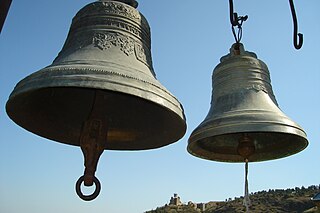
Tones of a bell are heard obscurely;
How old the sounds no sage has said,
Or yet explained the story surely.
From the lost church, the legend saith,
Out on the winds, the ringing goeth;
Once full of pilgrims was the path—
Now where to find it, no one knoweth.
 |
| public-domain-image.com |
Where no foot-trodden path is lying;
From the time's woe and discontent,
My heart went forth to God in sighing.
When in the forest's wild repose,
I heard the ringing somewhat clearer;
The higher that my longing rose,
Downward it rang the fuller, nearer.
So on its thoughts my heart did brood,
 |
| wikipedia |
That I have never understood
How I clomb up the height so dizzy.
To me it seemed a hundred years
Had passed away in dreaming, sighing—
When lo! high o'er the clouds, appears
An open space in sunlight lying.
The heaven, dark-blue, above it bowed;
The sun shone o'er it, large and glowing;
Beneath, a ministers structure proud
Stood in the gold light, golden showing.
It seemed on those great clouds, sun-clear,
Aloft to hover, as on pinions;
Its spire-point seemed to disappear,
Melting away in high dominions.
The bell's clear tones, entrancing, full—
 |
| wikipedia |
No human hand the rope did pull—
The holy storm-winds sweeping rung it.
The storm, the stream, came down, came near,
And seized my heart with longing holy;
Into the church I went, with fear,
With trembling step, and gladness lowly.


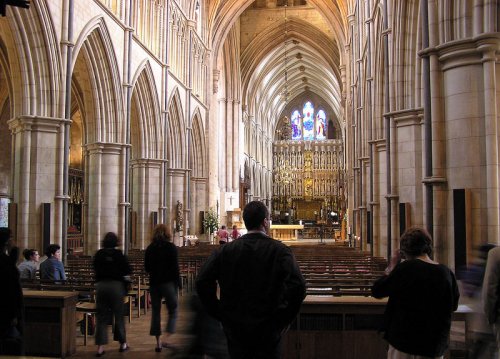
What in me moved; words cannot paint it.
Both dark and clear, the windows glow
With noble forms of martyrs sainted.
I gazed and saw--transfigured glory!
The pictures swell and break their barriers;
I saw the world and all its story
Of holy women, holy warriors.
 |
| london-traveltips.com |
My heart was like the face of Stephen.
Aloft, upon the arches holy,
Shone out in gold the glow of heaven.
I prayed; I looked again; and lo!
The dome's high sweep had flown asunder;
The heavenly gates wide open go;
And every veil unveils a wonder.
What gloriousness I then beheld,
 |
| digitalgallery.nypl |
What sounds triumphant on me swelled,
Like organs and like trumpets thunderous—
My mortal words can never tell;
But who for such is sighing sorest,
Let him give heed unto the bell
That dimly soundeth in the forest.'"
George MacDonald
(As a commentary on this poem, read the conversation after the poem is read in MacDonald’s Story, Adela Cathcart:
"What is the lost church?" asked Mrs. Cathcart.
"No one can tell, but him who finds it, like the poet," answered the curate.
"But I suppose you at least consider it the Church of England," returned the lady with one of her sweetest attempts at a smile.
"God forbid!" exclaimed the clergyman, with a kind of sacred horror.
"Not the Church of England!" cried Mrs. Cathcart, in a tone of horror likewise, dashed with amazement.
"No, madam--the Church of God; the great cathedral-church of the universe; of which Church I trust the Church of England is a little Jesus-chapel. . . “
"Whoever finds God in his own heart," said the clergyman, solemnly, "has found the lost Church--the Church of God.”)What else can I say? MacDonald does it best. Only this:
O God, you are my God.
Earnestly I seek you.
My soul thirsts for you,
My body longs for you
In a dry and weary land
Where there is no water.
I have seen you in the sanctuary
And beheld your power and your glory. . . (Ps. 63)
Monday, December 6, 2010
A Picture Lesson from a Church
 I love this picture. Something about it draws me. It is an African church.
I think I am moved by the concentration that these people are showing over the Bibles. They haven't just read the passage and then set it aside waiting for someone to tell them what it all means. It seems they are reading and re-reading the passage, seeking to really understand and take it all in.
Also the discussion from the gentleman in the group of listeners shows that this experience with the Bible is not merely passive. With the Bible open in his hand, he seems to really be expressing something from his heart.
Finally, the sparseness of their surroundings shows their desire to gather and study and ponder and learn even without a comfortable and easy situation.
Just a few things that may contribute to why this picture moves me. There is something fresh and unencumbered about it.
"Blessed is the man
who does not walk in the counsel of the wicked,
or stand in the way of sinners,
or sit in the seat of mockers,
but his delight is in the law of the Lord,
and on his law he meditates day and night." (Ps. 1:2)
Lord, may my heart come before you fresh and unencumbered as I feast on your word alone and may I find a place to feast as these people are doing with others. Let me bring my whole self to the meal and not just my mind or my feelings or my latest activities, but everything. My vision may be idealistic, but may it be supported by your grace and the power of your Spirit. Amen.
Subscribe to:
Posts (Atom)