About Me

My photo
I long to see Christ formed in me and in those around me. Spiritual formation is my passion. My training was under Dallas Willard at the Renovare Spiritual Formation Institute. One of my regular prayers is this: "This day be within and without me, lowly and meek, yet all powerful. Be in the heart of each to whom I speak, and in the mouth of each who speaks unto me."

Other Interests

Monday, October 22, 2012

A Heart that Is Free

A heart that is free
is close companion
 of a peaceful soul.

speak4justice

A free heart is one
that is not attached to its own way
of doing things,
that does not become impatient
when things don't go its way.


A free heart
will surely enjoy spiritual consolations,
but is not dependent on them
and will, to the best of its ability,
accept troubles in their stead.

A free heart
is not so tied
to a schedule or a way of praying
that any change is upsetting
and a source of anxiety.

A free heart is not attached
to what is beyond its control.

A free heart prays to God
that his name be hallowed,
that his kingdom come,
that his will be done,
on earth as it is in heaven.

For if the name of God is hallowed,
if his kingdom is in us,
if his will is being done,
a free spirit need not concern itself
with anything else.

(From Set Your Heart Free: The Practical Spirituality of Frances de Sales, pp.95-97)


Tuesday, September 25, 2012

Repentance: It's Not All that Bad

Repentance is not an emotion.  It is not feeling sorry for your sins.  It is deciding that you have been wrong in supposing you could manage your own life and be you own god; it is deciding that you were wrong in thinking that you had, or could get, the strength, education, and training to make it on your own; it is deciding that you have been told a pack of lies about yourself, your neighbors, and your world.   And it is deciding that God is Jesus Christ is telling you the truth.  Repentance is a realization that what God wants from you and what you want from God are not going to be achieved by doing the same old things, thinking the same old thoughts.  Repentance is a decision to follow Jesus Christ and become his pilgrim in the path of peace.  (Eugene Peterson, A Long Obedience in the Same Direction, p.30)
The kingdom of heaven is like treasure hidden in a field. When a man found it, he hid it again, and then in his joy went and sold all he had and bought that field.  (Matthew 13:44)
davidniblack.com
What if repentance didn't make you feel bad?  What if the emotional marks of repentance was love, joy, and peace?  When I think about it, I find that repentance usually ends up in relief and joy.  I can finally let go of something that I thought I needed because I find there is something else so much better and greater.

No, what makes me miserable is my resistance to repentance.  Approaching the corner I mean to turn, I find myself full of fear, worry, and even anger.  Part of me doesn't want to repent.  That's the part of me that causes all the pain.  Repentance is the relief, the sunrise.

So Jesus also explains some of the top "dreads" that keep me from repenting in another parable.
Listen then to what the parable of the sower means: When anyone hears the message about the kingdom and does not understand it, the evil one comes and snatches away what was sown in their heart. This is the seed sown along the path.  The seed falling on rocky ground refers to someone who hears the word and at once receives it with joy.  But since they have no root, they last only a short time. When trouble or persecution comes because of the word, they quickly fall away.  The seed falling among the thorns refers to someone who hears the word, but the worries of this life and the deceitfulness of wealth choke the word, making it unfruitful.  But the seed falling on good soil refers to someone who hears the word and understands it. This is the one who produces a crop, yielding a hundred, sixty or thirty times what was sown.  (Matthew 13:18-23)
Ignorance is the first.  What I don't know can hurt me.  Persecution is another problem.  Other people's resistance can become my resistance through fear.  Worry and greed can eventually outgrow even the best of news.

Repentance asks, seeks, and knocks.  Repentance must come from certainty and fearlessness.  Repentance must weed out worries and all sorts of lust and greed to last.  Such repentance doesn't yield a mere 10% in a year, but 30,000% to 100,000%.

Is Jesus exaggerating?  Is he just advertising the kingdom with the current marketing techniques?  The message is clear.  The influence and work of God in my life is more valuable than anything else.  It is worth giving it all away.  Repentance may seem foolish to those who cannot see the hidden treasure, but it makes perfect sense to the one who has found the treasure.

Lord, you are my treasure and my triumph.  Save me from all that would take me from you.  Let my decision be wise, fearless, and lasting.  Amen.

Thursday, September 6, 2012

The Reality of the Cross

 May I never boast except in the cross of our Lord Jesus Christ, through which the world has been crucified to me, and I to the world. (Galatians 6:14)
 The high point in human history - the cross! . . .  The single greatest force in human life [is] the cross.  And believing that totally flips everything upside down.  (Dallas Willard, Jesus and Culture, Divine Conspiracy talks)
The cross is not primarily a show of how bad people are, but how badly people need God.  Without God our efforts at good are always interrupted by necessity.  Peter felt it was necessary to deny Jesus even though he swore he would go to death with him.  Pilate felt it was necessary to turn Jesus over even though he could find no charges against him.  The Sanhedrin turned Jesus over to the Romans because it was necessary for one man to die rather than a nation.

The reality of the cross is that as a human being, when I try to do good on my own, I will inevitably find it necessary to overturn or betray that good for the sake of something "necessary."  The cross outlines the hope of all people.  When my life is turned over to God, the "necessities" become the very things I have to put to death.  Instead of crucifying what it good, true, and beautiful for the sake of these necessary desires and fears, I have to crucify these desires and fears.

"The wages of sin is death," says Paul.  Living apart from God, away from his grace, and on my own only results in a continuing death.  All that is good will be crucified because it threatens the "Almighty 'I will'".  This form of self-will must die if I am to live.

The high point of the cross is that it really changed everything.  The greatest discovery of humanity was made on the cross by the one who showed us everything a person should be, Jesus.  The cross is mine to boast in because it shatters all the lies that I am fed daily about this world and myself.  The cold, hard reality of the cross crowns the life Jesus lived in this world with the power to be humble, the joy to go through suffering, and the life to conquer death.  These are not mere ideas, but realities found in relationship with God.

The world is crucified to me through the cross.  All the glamour, the display of wealth and power, the fear and dread, the seemingly unending supply of pleasure and distraction turns out to be a lie.  The world is a worn-out shirt, ready to be retired.  The world is a defeated enemy, ready to be destroyed.  The world is uninteresting and bland, ready to be replaced and renewed.  The cross tears the mask off of the world of humanity working apart from God and for its own desires and shows it to be futile and empty, like a dying criminal on a tree.

I am crucified to the world through the cross.  I become an exile in this world rather than a resident.  I find myself "on the outside" in many situations.  Jesus said that the world will hate those who follow him as it hated him.  The systems and institutions set up without God or against him have no place for me.  Occasionally I am attacked or rejected, but mostly where I follow Jesus I am just ignored.

Lord, let the cross define my reality and my hope.  Let me be like Paul who boasts only in the cross of Christ.  Amen.

Monday, August 20, 2012

Renovare Essentials

Looking back over two years in the Renovare (reh-no-VAHR-eh) Spiritual Institute, I have changed my mind about several things in my walk with Jesus.  The new thoughts and ideas were only the beginning, but still an important beginning.  The best part of my learning was the discovery that these ideas are not new at all, but pillars of of thought and experience that reach back hundreds of years.  Renovare reintroduced me to these new/old ideas and showed me how they worked in real life.

The Renovare Essentials Conference overviews some of these ideas about Christian spiritual formation.  Dawn and I attended one of these conferences a couple of years ago.  We wanted to understand Renovare's goals and foundations better before investing ourselves into the Spiritual Institute as well as starting this education together as much as possible.  We drove to Phoenix to spend some time in learning, praying, and talking about all this calling from God.

The most pronounced theme of the Essentials conference was God's grace.  Dawn and I found this relieving.  Renovare has a lot of material about spiritual "disciplines" and we both are aware of the tendency to take these exercises and make them into competitions and divisions in churches, so grace was a great place to start.

What I needed to learn is that God's grace is not so much about fixing my past or securing my future as living in the present.  The forgiveness of my sins is essential, but it is not everything.  The open door  to heaven is my hope, but it is not all that there is.  God's grace is provision for my life, rather than for my death.  If God's grace is God acting in my life, it is not an "over-and-done" thing as much as the living hand of a living God.  The question in my life has moved from "How can I or anyone else get saved by grace?" to "How can I or anyone else live by God's grace from moment to moment?"

Dallas Willard says,"God's grace is opposed to earning, not opposed to effort."  This expresses another idea I learned at the Essentials Conference.  The proper response of my will to God's grace is more about training that trying.  Because of God's mercy, he is not opposed to my trying, but also because of his mercy he tells me that trying will not accomplish what he wants in my life.  Jesus makes this plain when he speaks about following him: "Whoever does not take up his cross and follow me is not worthy of me."  (Matthew 10:38)  The grace of Jesus calls for great effort.  The point of this grace is Christ-likeness.

In areas of importance, training is required.  People do not speak of medical trying, but medical training.  The same is true for the military, musical performance, and pastoral work.  People do not trust someone who has merely tried the field, but someone who has trained in the field.  The orientation of the will is different when a person trains for something as opposed to when they try something.  Because of the importance of following Jesus, discipleship requires the intention of training and not merely trying.

With grace as the motivation and hope and with training as my intention, I found myself asking about the actual means of Christian spiritual formation.  This is where spiritual exercises enter.  The means of producing spiritual change in my life is very rarely direct.  I cannot become humble, patient, or joyful by just practicing being humble, patient, of joyful.  This is the fast track to burnout and frustration.  Instead of focusing on the direct practice of being joyful, I learned that I needed to indirectly exercise in order to obtain joy or patience or humility.

Lifting weights is an example of and indirect exercise.  Most people do not lift weights to get better at lifting weights, but in order to enhance their ability elsewhere.  Exercise indirectly prepares a person for practice.  Without adequate strength poor performance and injury result.  Similarly, solitude, silence, fasting, and prayer can be exercise that prepare me for practicing a life with God.  

Without spiritual exercise, spiritual practice is powered by my own abilities and costs me dearly.  I cannot make myself grow, but I can be prepared for the spiritual growth and change that God's grace brings.  Spiritual exercises are the means of effort that work God's grace into my life and train me for my work with God in my life.

For Christian spiritual formation, God's action in my life - his grace - is the most essential.  This grace, by its very nature, calls out a response beyond trying: training.  In this training, spiritual exercises are a primary means by which the Spirit forms me into Christ-likeness.  The Renovare Essentials Conference will examine and teach these ideas and the ways to work them into everyday human life.

Friday, July 13, 2012

Let's Argue

Come.  Sit down.  Let's argue this out.  (Isaiah 1:18)
Love the Lord your God . . . with all your mind. (Luke 10:27)
 Argument has always been a bad word for me.  I do not like argument.  I have felt that the only people who like arguments are difficult and unpleasant sorts of people who like to be bothersome.  My policy has been, "Only jerks like to argue."

Not only personally offensive, I have also seen argument used as a political tool which only seeks to gain votes and popularity by "scoring hits" against an opposing candidate/side.  Really, it seems mostly equivalent to mudslinging. Slogans and misrepresentation dominate the whole face of this sort of argument in my mind.

So why would God want to encourage us to argue?  Is he welcoming attacks and mudslinging or encouraging the worst in me to come out in a verbal fight?  In one sense, I do believe that he is risking attacks and misunderstanding through inviting me to argue it out with him.  Of course, I will be tempted to pull whatever stunts I can to win, since that is at the heart of what it means to be a person trying to make it without God.  Inviting argument seems to put us on opposite sides in a fight.

Although God is willing to take the risk, it does not seem that is his goal.  Perhaps argument can be something else.  Perhaps it can be God exercising my reasoning and respecting my will.  Perhaps it can be a place where I can learn to love God's thoughts and will rather than be bullied and pushed by a superior being.  God comes down to me and says "Let's argue this out" rather than merely overpowering me.

If God invites argument for the sake of growing in my thought and exercising my will, could it be that such arguing might be helpful between people as well?  Maybe rewording it "discussing" would help, but only if the whole process were saturated with humility and a desire to find truth.  It has not helped to claim that there is no Truth only "truths" we individually espouse.  Such a view has a questionable view of reality as well as only entrenching us in our viewpoints and encouraging us to gather ammunition so that the most powerful ideology wins, rather than seeking out what is true and right and good together.

As far as convincing another person of my argument, I had a talk with my daughter that helped us both to understand a place that discussion and argument might have in that process.  We were talking about evangelism.  We both felt that a person cannot be argued into the kingdom of God.  Winning an argument does not equate to "winning a soul."  But while that seems true, it also seems true that an argument can keep a person out of God's kingdom.  Arguments (philosophically speaking, as premises which step to a conclusion) provide barriers or stepping stones to trusting God.  Discussing such things may enable some people to see a way through to trusting God.

There are two barriers in an argument that might keep a person from trusting God.  Either the person thinks the argument is not sound or he does not like the conclusion.  An unsound argument is either logically invalid or it has a false premise.  For example, contradiction is one thing that renders an argument invalid, like "All religions are true and all religions are false."  Or a premise itself might be false, like "God causes all suffering."  The other possibility is that the conclusion is not preferable to a person like, "Therefore, God exists and God is good."

If an argument were explored carefully and kindly, such barriers might become clearer.  Either person might find themselves questioning the soundness of their arguments or beliefs.  Either person might come to a place where they realized their main objection was the conclusion even if the argument was sound.  If God wants me to think about things, I might be able to think them through with other people without needing to push, presume, or pretend so that I can win.  If winning were not my goal, I might have more influence with other people and who knows, I might even learn something myself.

Lord, show me how I can get past my fears of argument and discussion and grow in my thinking and deciding.  Help me to kindly invite other people to join me in thinking and growing.  I want your invitation to "argue it out" to not scare me, but remind me of how much you love and respect me and desire me to walk with you as a friend.  Amen.

Saturday, June 23, 2012

A Right Relationship to God

Are we prepared to leave ourselves resolutely alone and to launch out into the priestly work of prayer?  The continual grubbing on the inside to see whether we are what we ought to be generates a self-centered, morbid type of Christianity, not the robust, simple life of a child of God.  Until we get into a right relationship to God, it is a case of hanging on by the skin of our teeth, as we say.  (Oswald Chambers, My Utmost for His Highest, June 21)
Recently I had one of my "feel sorry for myself" episodes.   I have trouble with the prayer of examen at times.  When I look closely at my conscience and the desires I struggle with, I am appalled.  I think one reason is that I am hoping for a cure more than for God's grace; I want to be free from the things that tie me to God's mercy.  At the heart of it, I think I get angry because I cannot achieve autonomy more than being sorry for my sins.  I become increasingly self-centered and morbid in these moods.

The encouragement to leave myself "resolutely alone" reminds me that my even if my goal is merely to get better and grow stronger, I will not get anywhere without God at my side.  I was not made to "go it alone."  I was made to be in a close conversational relationship with God.  Jesus as the Son of Man, the ideal person, shows this in his life and words.  Everything he does is done with the Father at his side - and he has no sin in his life.

Actually, this is the essence of freedom from sin: living with the Father at my side.  Sin is merely what I do when I do not live this way.  Sins are the particular things I do in order to try to live without the Father on my own steam.  They are indicators of what my life is like without the Father.

The answer, then, is not looking inside and trying to figure out how I can get rid of sin so I can get back to God.  Since the source of my sins is distance from God, I cannot fix them apart from seeking the "right relationship" with him, a relationship of trust and continual interaction.  Like marriage, my relationship with God is repaired and deepened with the right kind of relationship with God.  Marriage is not what I do for my wife or how I think about her as much as what we do together.  Like family, my relationship with God is not merely something I work for, but something I must participate in and enjoy.  Family is not what I bring home for my kids or what opportunities I give them as much as how we live together and love each other.  A "right" relationship with God is not what I do for God or what I think about him as much as how we do life together, as a Father and son, or as a master and apprentice.

My sins, then are my efforts to live apart from this relationship and replace it with another kind.  Sins are the cracks and empty places in my life where God needs to be in order for my life to be restored and full.  Maybe I need to think about God less and exercise my fondness for him.  Maybe I need to do less for him and do more with him.  The greatest danger to my relationship with God, I think, is my service to God.  My sins tell the story.

Lord, I get knotted up inside when I try to fix myself apart from seeking you.  I will seek you, O God; your face will I seek.  In being with you as a Father, I know I will find repair and restoration.  I will find myself safe and sound in that relationship.  Instead of seeking to please you, help me to trust you more and walk with you consistently through this day and each day.  Amen.

Monday, June 4, 2012

"A Quiet More Deep Than Death"

Rest

I.

When round the earth the Father's hands
  Have gently drawn the dark;
Sent off the sun to fresher lands,
  And curtained in the lark;
'Tis sweet, all tired with glowing day,
  To fade with faded light;
To lie once more, the old weary way,
  Upfolded in the night.

A mother o'er the couch may bend, And rose-leaf kisses heap: In soothing dreams with sleep they blend, Till even in dreams we sleep. And, if we wake while night is dumb, 'Tis sweet to turn and say, It is an hour ere dawning come, And I will sleep till day.


II.

There is a dearer, warmer bed, Where one all day may lie, Earth's bosom pillowing the head, And let the world go by. Instead of mother's love-lit eyes, The church's storied pane, All blank beneath cold starry skies, Or sounding in the rain.

The great world, shouting, forward fares: This chamber, hid from none, Hides safe from all, for no one cares For those whose work is done. Cheer thee, my heart, though tired and slow An unknown grassy place Somewhere on earth is waiting now To rest thee from thy race.


III.

There is a calmer than all calms, A quiet more deep than death: A folding in the Father's palms, A breathing in his breath; A rest made deeper by alarms And stormy sounds combined: The child within its mother's arms Sleeps sounder for the wind.

There needs no curtained bed to hide The world with all its wars, Nor grassy cover to divide From sun and moon and stars A window open to the skies, A sense of changeless life, With oft returning still surprise Repels the sounds of strife.


IV.

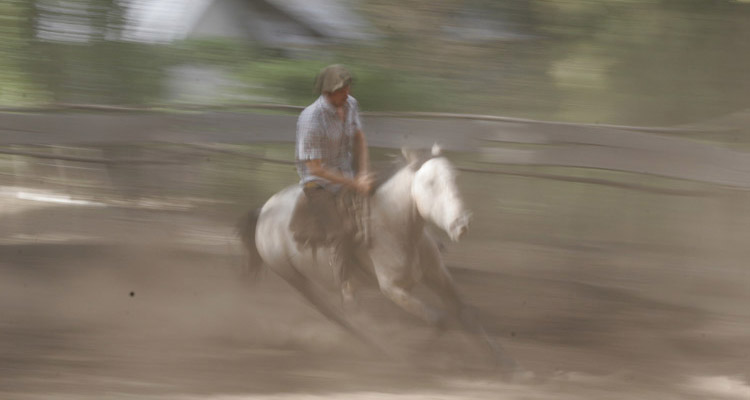
As one bestrides a wild scared horse Beneath a stormy moon, And still his heart, with quiet force, Beats on its own calm tune; So if my heart with trouble now Be throbbing in my breast, Thou art my deeper heart, and Thou, O God, dost ever rest.

When mighty sea-winds madly blow, And tear the scattered waves; As still as summer woods, below Lie darkling ocean caves: The wind of words may toss my heart, But what is that to me! 'Tis but a surface storm--Thou art My deep, still, resting sea.


(Geroge MacDonald,1864)